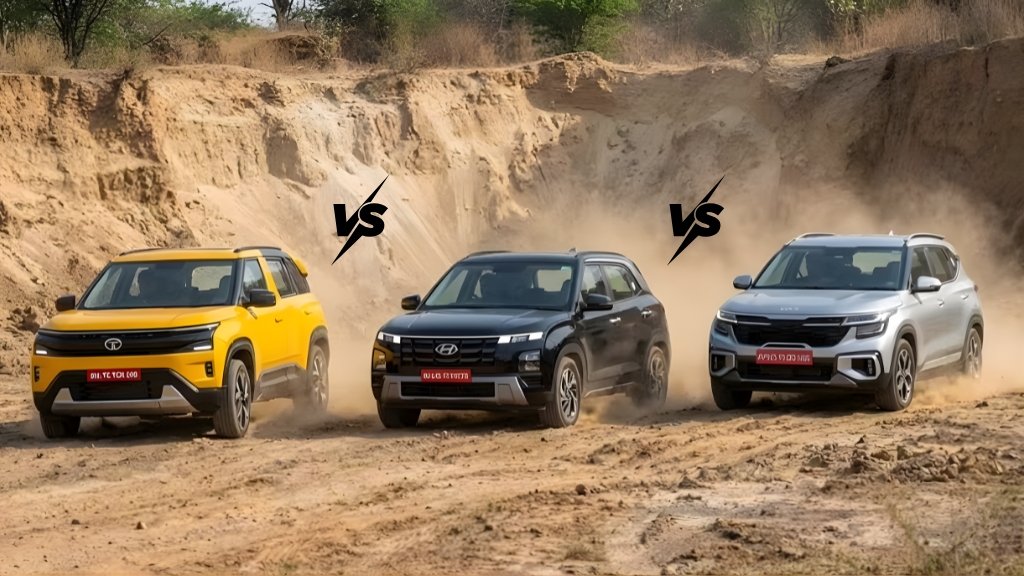
The compact SUV segment in India and many global markets has become a crowded, fiercely competitive battleground where perceived value, real-world practicality and up-to-date technology decide winners. The Tata Sierra, Hyundai Creta and Kia Seltos are three of the most influential players in this category and buyers frequently ask which of them offers the best combination of price, equipment and usable performance.
In this comparison we look beyond headlines and brochure numbers to compare the three models on the concrete criteria that matter most to everyday owners: price and value across variants, space and packaging, engine and drivetrain options, ride and handling in typical urban and highway scenarios, safety and equipment, running costs and ownership experience. The aim is to give a pragmatic guide that helps readers choose the right car for their priorities rather than simply aggregating statistics. Throughout the article we will explicitly compare Tata Sierra vs Hyundai Creta vs Kia Seltos by name and by real-world usage so you can translate this analysis into a test drive checklist and final purchase decision.
Price, trims and how they shape value of Tata Sierra vs Hyundai Creta vs Kia Seltos
Price remains a critical pivot in the compact-SUV decision process because it directly influences insurance, tax, loan installments and perceived value retention. Each model offers a ladder of trims that target slightly different buyer priorities: the Tata Sierra tends to undercut rivals on headline prices in several markets while offering strong standard equipment in mid-trims; the Hyundai Creta typically presents a broad variant spread that allows fine-grained choice between value and convenience; the Kia Seltos positions some of its higher trims as premium, with feature-rich packages that aim to beat rivals on perceived content-per-rupee.
In practice you should compare identical-equipment levels rather than base-to-base or top-to-top prices: a mid-spec Creta with adaptive cruise, ventilated seats and sunroof may cost the same as a top-trim Sierra that swaps some luxury niceties for better warranty or service coverage.
Local incentives, dealer discounts and exchange offers can shift the balance substantially at purchase time, so always compare on-the-road pricing with comparable warranty inclusions. Depreciation patterns differ: the Creta and Seltos have historically held value well thanks to strong brand recognition and demand for specific trims, while the Sierra’s resale is competitive but more sensitive to perceived service coverage and parts availability. If your priority is lowest initial outlay for the best equipment, Tata often surprises; if you want balanced variants and predictable resale, Hyundai and Kia remain strong.

Interior space, ergonomics and practical packaging
All three compact SUVs capitalise on a tall greenhouse and efficient footprint, but their philosophies diverge in detail. The Tata Sierra emphasises roomy rear seats and a flat-ish floor that benefits three-across occupants on short trips; its boot space is class-competitive and the loading lip is user-friendly for daily chores. The Hyundai Creta focuses on sculpted passenger accommodation and a driver-centric cockpit that organises controls logically and offers great visibility for urban driving, while its rear-seat comfort is generous across the segment.
The Kia Seltos often matches the Creta in measured dimensions but adds slightly more usable stowage—deep door bins, clever cubbies and an intuitive centre console—making it very practical for families who need organised daily storage. Ergonomics follow brand DNA: Hyundai keeps the most neutral, universally comfortable driving posture, Kia adds a slightly sportier seating orientation in higher trims, and Tata prioritises elevated seating for load visibility and ingress/egress ease.
Material quality and finish also affect perceived value: Seltos and Creta often present slightly more premium soft-touch surfaces in upper trims, while Sierra offers robust, easy-care materials that tolerate heavy family use. If rear-seat duty and luggage capacity are decisive, inspect each car with the seats occupied and luggage packed to check real-world usability rather than relying solely on cubic-litre figures.
Engines, transmissions and real-world performance
Engine choice and gearbox calibration make the difference between an SUV that feels willing in traffic and one that feels strained. The trio offers a mix of petrol and turbo-petrol engines, and in some markets diesel options persist for buyers who log high mileage or need towing capacity. The Hyundai Creta and Kia Seltos share powertrains across many variants, benefitting from common development and calibrated automatics that are smooth and well-suited to urban stop-start flows; turbo petrols in these two cars produce lively mid-range torque which makes overtakes and uphill work feel effortless.
The Tata Sierra often offers torque-rich petrols tuned for city responsiveness and fuel economy, and its gearbox choices—manual, dual-clutch or torque-converter automatic depending on variant—are matched to the engine’s character so the car feels coherent in daily use. For highway cruising, consider top-gear ratio and NVH: Creta and Seltos typically run quietly and with modest revs at cruising speeds, whereas Sierra can show more engine presence depending on the chosen motor and trim.

Real-world fuel economy also depends on weight, tyre choice and driving style; turbocharged versions give better overtaking flexibility but slightly higher fuel usage in aggressive driving, whereas naturally aspirated units are smoother in traffic and generally frugal. If you cover long distances frequently, prioritise the drivetrain that balances low-rpm torque and tested long-distance refinement.
सम्बंधित ख़बरें
Ride, handling and driving comfort in everyday use
None of these cars were designed as track toys; they are tuned for a compromise between compliant ride and confident handling. The Tata Sierra’s suspension often leans toward comfort, with slightly softer damping that soaks up city potholes and moderates jolt on broken surfaces, making it an excellent family cruiser on mixed roads. The Hyundai Creta strikes a balance: it offers predictable turn-in and a measured body control that reassures on twisty routes while remaining comfortable over urban imperfections.
The Kia Seltos frequently emphasises sharper steering feedback and tighter body control in its sportier trims, appealing to drivers who like a firmer connection to the road without significant compromise to ride comfort. Tyre choices and wheel size materially alter these characteristics—larger alloys make all three feel firmer and can transmit more road harshness into the cabin—so test the exact variant you intend to buy on local roads to understand the ride trade-offs. Braking performance is competent across the board, but tuning differences mean pedal feel and initial bite might suit one driver more than another; always test emergency stops and low-speed modulation.
Safety, equipment and technology
Safety and tech are area where differentiation is strong and often decisive. The Hyundai Creta and Kia Seltos, sharing platforms and components, tend to offer advanced active safety packages at higher trims—adaptive cruise control, blind-spot monitoring and parking assist features—whereas the Tata Sierra emphasises strong passive safety with a robust occupant cell and standard airbag coverage across many trims. All three now include multi-airbag systems, ABS with EBD and stability control on most mid and upper trims, but the Creta and Seltos often package ADAS features more aggressively, reflecting a strategy to command higher top-trim prices with tangible capability.
Infotainment systems in the Creta and Seltos are usually polished with crisp displays and intuitive layouts; Tata’s system is straightforward and improving rapidly, with strong smartphone integration and useful telematics in higher trims. For safety-conscious buyers, examine actual ADAS behaviour during a demo drive: how smoothly the lane-keeping assists intervene, how reliably automatic emergency braking detects cyclists and pedestrians at typical city speeds, and whether the parking cameras and sensors present useful angles in everyday manoeuvres. Independent crash-test ratings and long-term reliability data should be factored into the buying decision where available.

Running costs, service network and ownership experience
Total cost of ownership often outweighs initial sticker shock over a typical 3–5 year ownership window. Fuel economy, service intervals, parts pricing, insurance and expected depreciation are the levers that determine lifecycle cost. Historically Hyundai and Kia have enjoyed strong dealer penetration and predictable parts pipelines, which simplifies servicing and maintains resale desirability. Tata has aggressively expanded its service footprint and warranty offerings, and its cars often cost less to buy and insure in many markets, which may offset any perceived resale gap.
Warranty and service packages—free service years, extended warranty options, and roadside assistance—can swing value significantly; always factor in the cost of the recommended service schedule and the nearest authorised service centre. Practical ownership factors like service appointment availability, turnaround times and loaner vehicle provisions can materially affect ownership happiness, so ask local dealers for typical service lead times and check community forums for real owner feedback on common issues and maintenance costs.
Conclusion
Choosing between the Tata Sierra, Hyundai Creta and Kia Seltos comes down to prioritising the features that matter most to you: if your primary goal is the lowest purchase price with sensible equipment and a family-friendly interior the Tata Sierra can be an attractive and practical choice; if you value a broad, well-calibrated variant ladder and strong residuals the Hyundai Creta’s balance of comfort, technology and brand strength is persuasive; if you prioritise a slightly more premium interior, sharper dynamics and feature-packed top trims the Kia Seltos is a compelling option.
For hands-on buyers the recommendation is simple: test-drive the exact variants you are likely to buy with typical loads and on your usual roads, compare on-the-road pricing including warranties and dealer packages, and evaluate long-term service and parts support in your locality. In comparing Tata Sierra vs Hyundai Creta vs Kia Seltos focus on how each car performs in the specific contexts you will use it—school runs, highway commutes, family trips and occasional heavy loads—and let that real-world appraisal guide your final decision.
Disclaimer: This article is informational and synthesises typical market features, driving impressions and ownership considerations; readers should verify the latest variant specifications, price, warranty and local service information with authorised dealers before finalising any purchase.